CAPE BOILER & HEATER CO
CASE STUDY
Customer: CAPE BOILER & HEATER CO.
Location: Cape Town, SA
Year: September 2025
Boiler: THERMAX Thermal Oil Heater
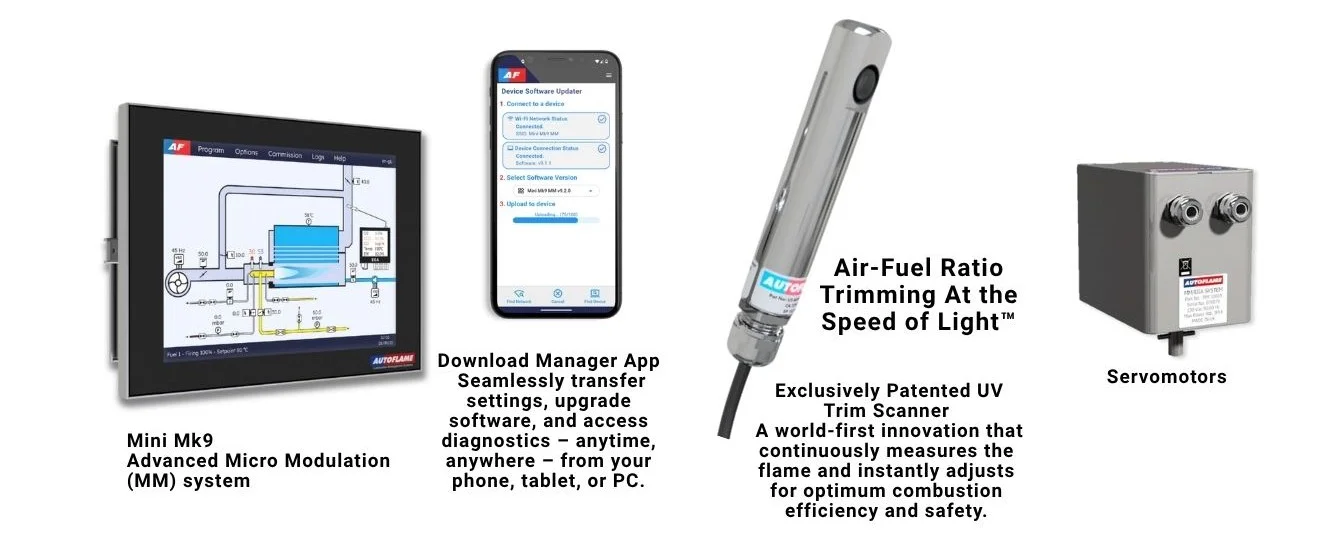
Controller: Autoflame Mini MK9 MM advanced controller, Autoflame MK9 UV O2 Trim scanners, Autoflame Servomotors
Fuel: This patented system is compatible with a wide range of fuels including natural gas, diesel, heavy fuel oil, and biofuels
SCOPE OF WORK
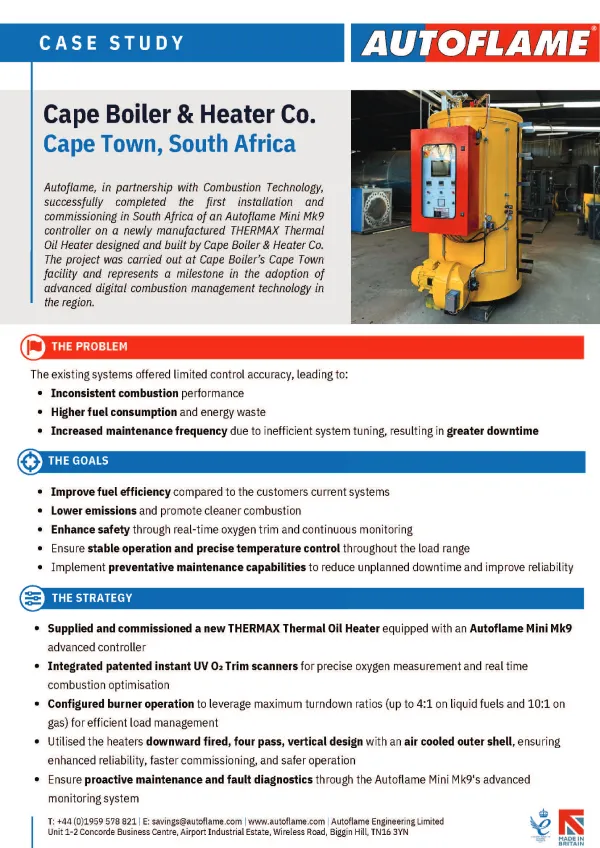
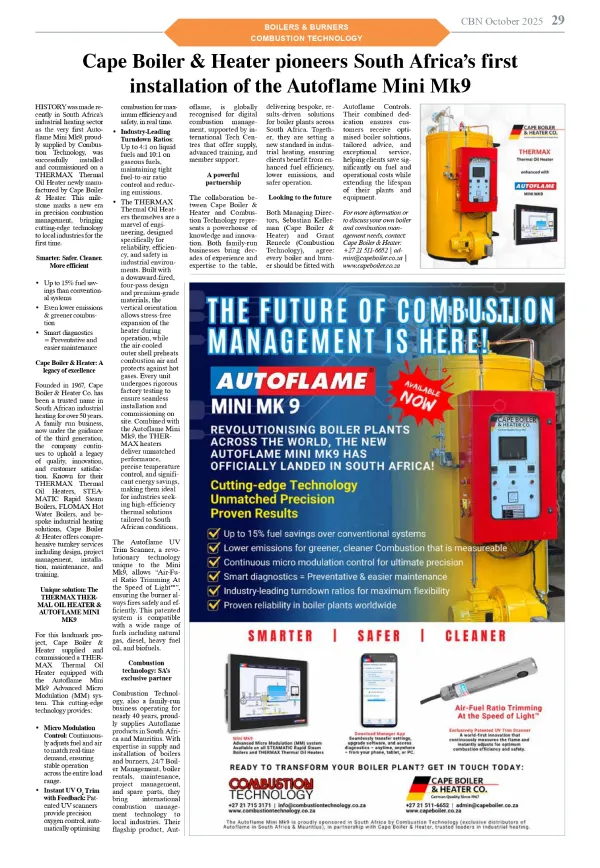
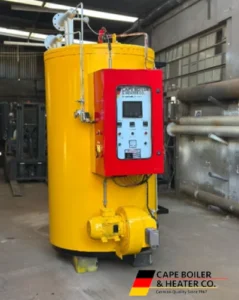 Cape Boiler & Heater Co., in partnership with Combustion Technology, successfully completed the first installation and commissioning in South Africa of an Autoflame Mini Mk9 controller on a newly manufactured THERMAX Thermal Oil Heater designed and built by Cape Boiler & Heater Co.
The existing systems offered limited control accuracy, leading to:
- Inconsistent combustion performance
- Higher fuel consumption and energy waste
- Increased maintenance frequency due to inefficient system tuning, resulting in greater downtime
KEY OBJECTIVES
- Improve fuel efficiency compared to the customers current systems.
- Lower emissions and promote cleaner combustion.
- Enhance safety through real-time oxygen trim and continuous monitoring.
- Ensure stable operation and precise temperature control throughout the load range.
- Implement preventative maintenance capabilities to reduce unplanned downtime and improve reliability.
INSTALLATION DETAIL
- Supplied and commissioned a new THERMAX Thermal Oil Heater equipped with an Autoflame Mini Mk9 advanced controller.
- Integrated patented instant UV O₂ Trim scanners for precise oxygen measurement and real time combustion optimisation.
- Configured burner operation to leverage maximum turndown ratios (up to 4:1 on liquid fuels and 10:1 on gas) for efficient load management.
- Utilised the heaters downward fired, four pass, vertical design with an air cooled outer shell, ensuring enhanced reliability, faster commissioning, and safer operation.
- Ensure proactive maintenance and fault diagnostics through the Autoflame Mini Mk9’s advanced monitoring system.
BENEFIT AND COST SAVING ACHIEVED
- Achieved up to 15% energy savings through optimised combustion control.
- Delivered significant emissions reductions, meeting modern efficiency and environmental standards Improved safety and reliability via continuous O₂ trim and real time performance monitoring.
- Reduced unplanned downtime and maintenance costs through built in diagnostic and preventative maintenance features.